


"I've done sudoku every morning for fifteen years. Two weeks with this and I haven't touched one since."
Train Tracks: 200 Logic Puzzles For Adults
Train Tracks: 200 Logic Puzzles For Adults
URGENT: We're running super low on stock. Get yours before we sell out!
Sharpen your logic & critical thinking daily
All the logic of sudoku, none of the repetition
Solve by deduction, never guesswork
Build focus that holds for hours
BUNDLE & SAVE
Couldn't load pickup availability

Train Tracks: 200 Logic Puzzles For Adults
100% money-back guarantee
What's inside?
What's inside?
200 train track puzzles inside - 100 on 6x6 grids to warm up on, 100 on 8x8 grids to push you. Full solutions sit at the back, and the book is pocket-sized, so it travels wherever you do. Numbers in, track out, one correct answer every time.


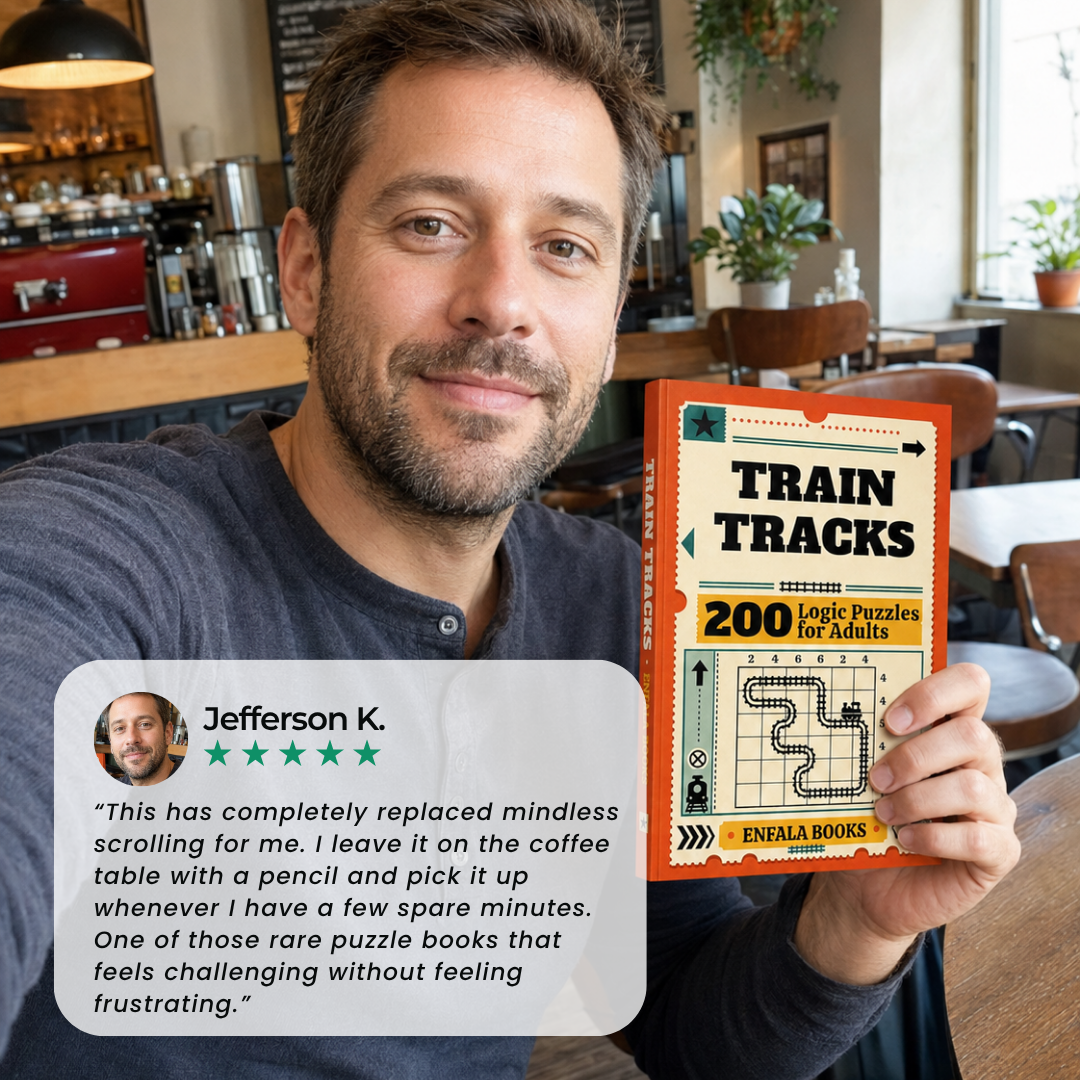
Think faster, reason clearer, miss less
You're not bored of puzzles, you're bored of the same puzzle.
'Train Tracks' uses the number logic you already know from sudoku, but the answer is a route only deduction can find - sharpening your reasoning, speeding up how you think, and giving you 200 puzzles that never repeat themselves.
solve at your own pace, anytime, anywhere

Train the skill you use every day without noticing
You know the feeling - a decision that shouldn't be hard just sits there, because you can't tell which piece to work from first.
That's what every track teaches. Start with little, reason from what has to be true, narrow until one answer survives.
Do it 200 times and it stops being a skill you only use for puzzles - it's just how you think.
100 6x6 grids to warm up, 100 8x8 to push yo

Everything waiting inside...
Inside these pages you'll find 200 puzzles built to make you reason your way to certainty - and the thinking skills that come with them:
How to work from a handful of numbers to the one route that fits
Why not a single puzzle here needs guessing - and how that trains real deduction
How the same reasoning starts showing up outside the book
100 6x6 grids to build the logic on, at a difficulty that never feels punishing
100 8x8 grids that push you to hold several deductions at once
How to spot the one move that unlocks the rest of the grid
Full solutions to all 200 puzzles, so you never lose an evening to one
Why the answer is always provable - and never a matter of luck
What readers reported after finishing:
94%
said their logical thinking felt sharper within two weeks
89%
preferred it to the sudoku books they'd been working through
91%
said they were reaching answers faster by the second half of the book
Results concluded from an 8-month post-purchase survey campaign in 2025.
6,300+ sharper minds, one track at a time
-

My head feels quicker!
I don't know how else to put it. Problems at work that I'd have chewed on for an hour, I'm now seeing the shape of in ten minutes. I'm three quarters of the way through and I'm not planning on stopping.
-

I ordered two more copies.
Bought it for myself, then realised my dad would love it, then my sister spotted it on the kitchen table and claimed it as her favourite thing in the house. The pocket size means mine now lives in my bag permanently.
-

I've finally quit sudoku.
I did a sudoku with my coffee every single morning for the best part of a decade, and I'd stopped enjoying it years ago. This gives me the same kind of thinking with something actually new to solve. My sudoku book has been in a drawer since March.
-

Not one puzzle needs a guess!
That's what sold me. Every single track can be worked out properly if you take your time, so there's never that moment where you've filled it in and you're not sure if you actually solved it or got lucky. Really satisfying.
-

The 8x8 grids are the real test.
The first hundred eased me in nicely and I got a bit cocky. Then the 8x8s started demanding I hold three or four deductions in my head at once. Hardest fun I've had in ages.
-

It replaced my evening scroll.
I used to lose an hour to my phone every night and feel worse afterwards. Now I do four or five of these instead. Same absorption, completely different feeling at the end of it.


Frequently Asked Questions
I've never played Train Tracks before. Will I be able to pick it up?
I've never played Train Tracks before. Will I be able to pick it up?
Yes, and most people are solving confidently within three or four puzzles. Each grid gives you a starting point, an ending point, and numbers telling you how many track pieces belong in every row and column. You lay a single continuous track between the two points that satisfies every number. The rules take a minute to learn and a lifetime to get bored of.
Do I need to be good at math?
Do I need to be good at math?
Not at all. The numbers tell you how many track pieces go in each row and column, so the only arithmetic involved is counting to eight. Everything else is pure logic and deduction.
How is this different from sudoku?
How is this different from sudoku?
It runs on the same kind of number logic, so the skill you've built carries straight over. The difference is what you're producing: instead of filling a grid with digits, you're building a single route across it. That one change makes every puzzle feel like a new problem rather than the same one in a different order.
Is there ever any guessing involved?
Is there ever any guessing involved?
Never. Every puzzle inside has exactly one valid route, and that route is always reachable through logic alone. You'll never finish a grid unsure whether you solved it or got lucky.
How difficult are the puzzles?
How difficult are the puzzles?
The book is split into two halves. The first 100 puzzles use 6x6 grids and ease you into the logic without ever feeling punishing. The second 100 move up to 8x8 grids, which ask you
Are the solutions included?
Are the solutions included?
All 200 of them, printed at the back. If a track defeats you, you can check the answer, see where your reasoning went sideways, and move on rather than losing an evening to one grid.
How long does a single puzzle take?
How long does a single puzzle take?
Most 6x6 grids take five to ten minutes once you're comfortable, and the 8x8 grids typically run fifteen to twenty-five. It's built for the gaps in your day rather than requiring a cleared afternoon.
Will this actually improve my thinking, or is that just a claim?
Will this actually improve my thinking, or is that just a claim?
Every puzzle asks you to start with incomplete information, reason from what has to be true, and narrow down until one answer remains. That's the same process behind good decisions, spotting flawed arguments, and thinking a few steps ahead. Do it 200 times and it becomes a habit rather than an effort.
Need help?
We got you! Our support team is available 7 days a week to assist you with every possible worry - just message info@senfold.com & we will be more than pleased to help you.
Free & easy returns
No stress, no hassle. If you need to return your order, we make it simple. Our team is here 7 days a week to help you every step of the way.